Gene Expression Visualization
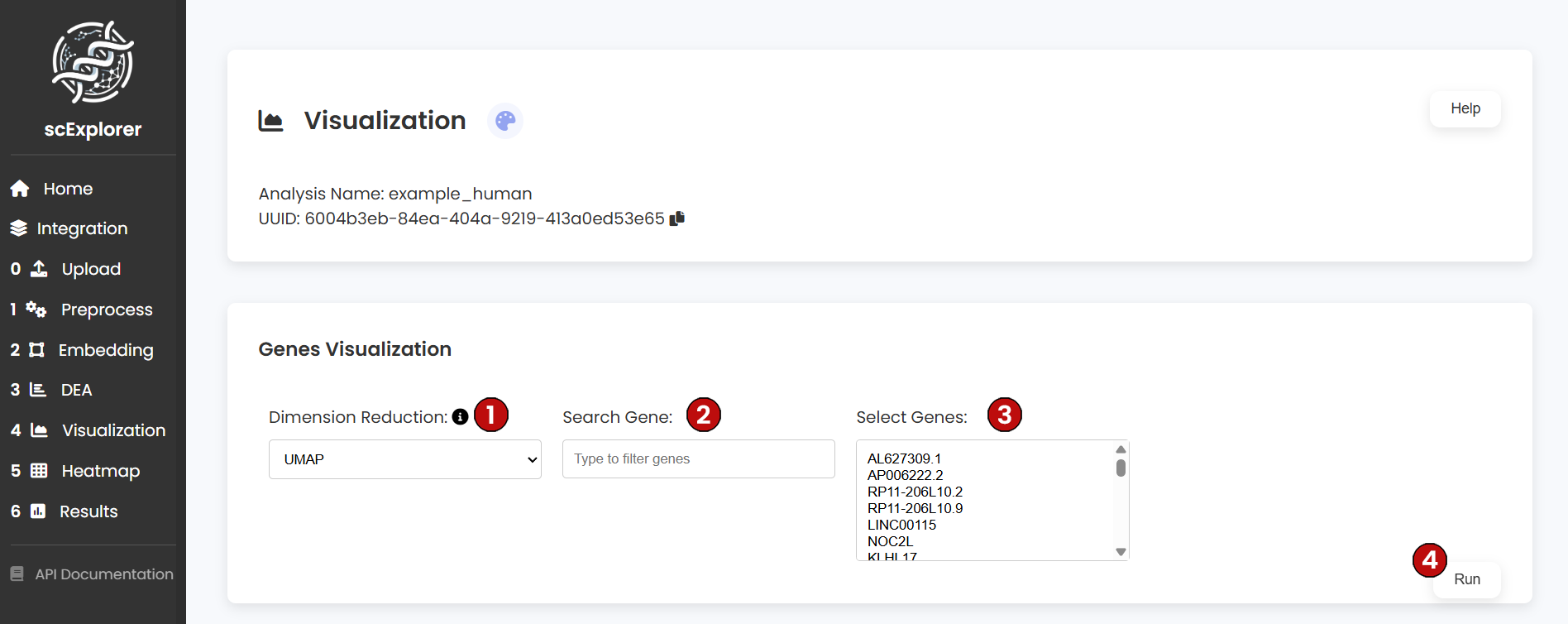
The visualization module allows you to explore gene expression patterns across your single-cell dataset by plotting specific genes of interest in reduced dimensional space (UMAP or PCA).
Step-by-Step Visualization Process
- (1) Select Dimension Reduction: Choose between UMAP or PCA for your visualization space
- (2) Search Genes: Type the genes of interest in the search field
- (3) Review Selection: The selected genes will appear on the right side for confirmation
- (4) Run Analysis: Click on Run to start the visualization process
- (5) Continue: Click on Continue to Results to proceed to the download section
Understanding Visualization Results
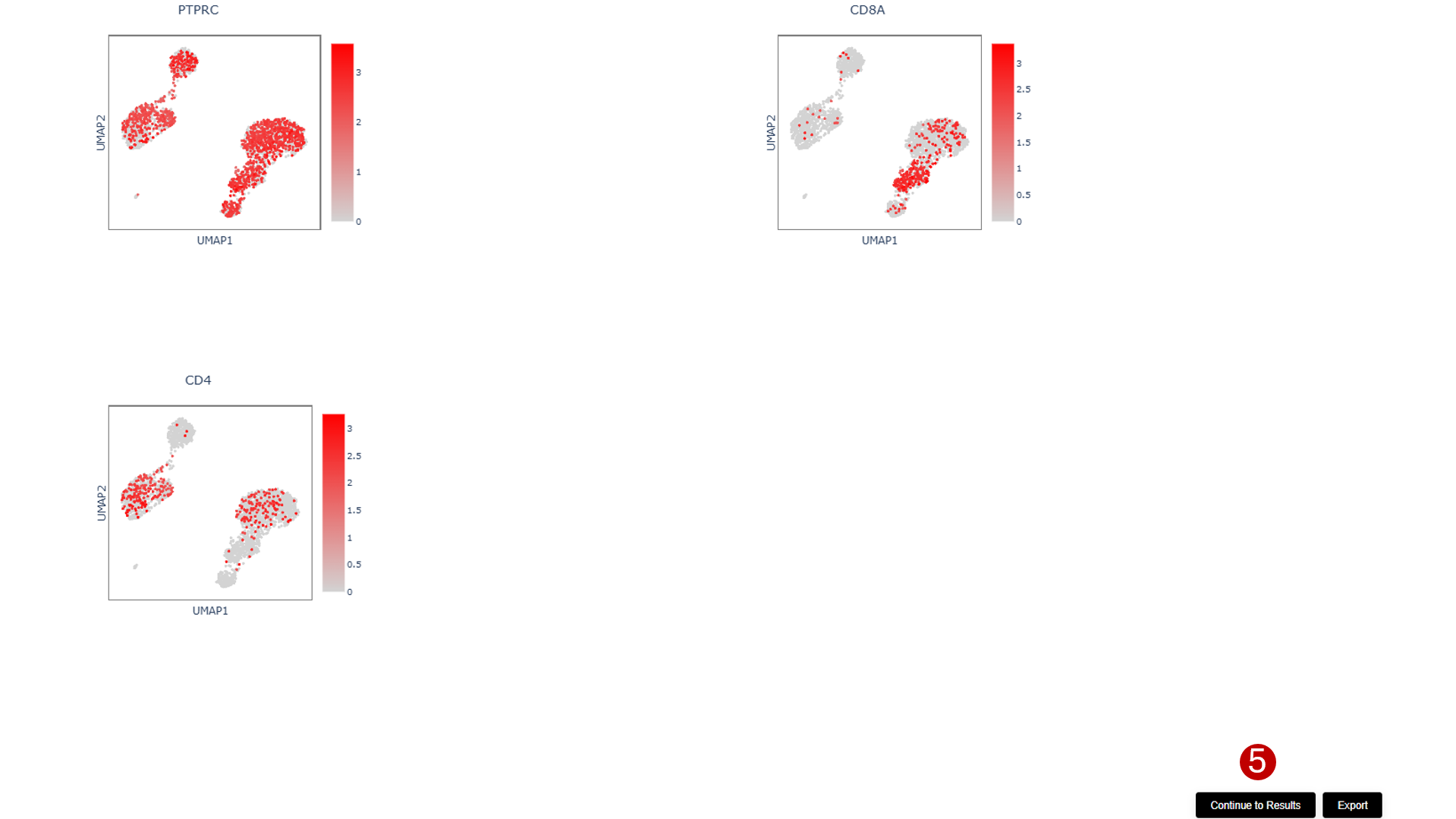
After running the visualization, you will see gene expression plots overlaid on your chosen dimensional reduction space. Each plot shows:
- Cell positions: Based on UMAP or PCA coordinates
- Expression levels: Represented by color intensity
- Spatial patterns: Revealing which cell populations express your genes of interest
This spatial representation helps identify cell types, validate clustering results, and understand the biological context of your single-cell data.
Feature Metadata Summaries
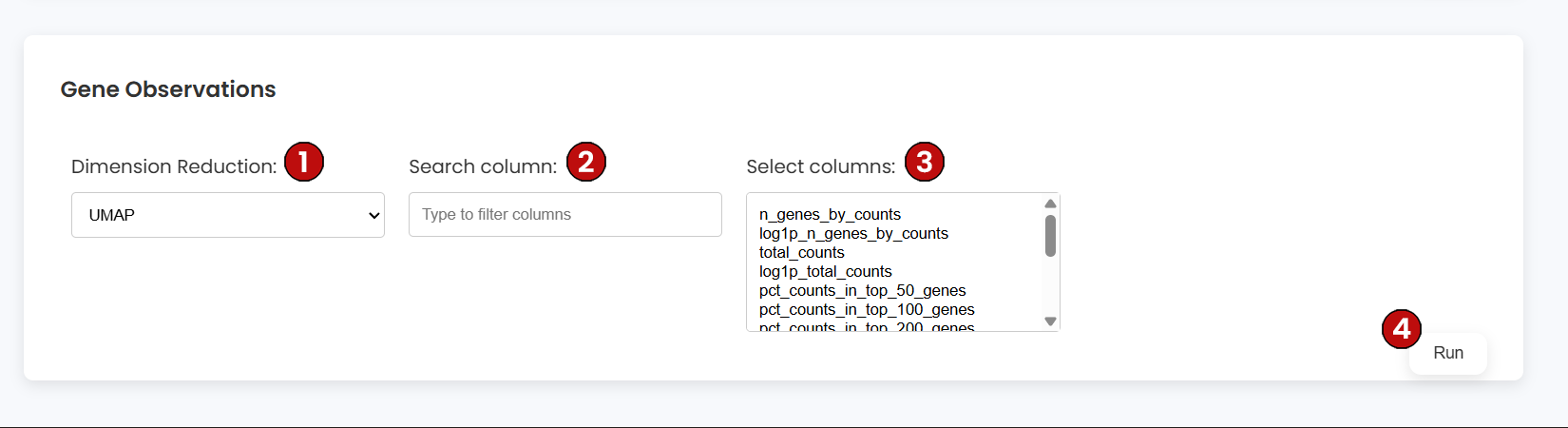
Use the Feature Metadata container to summarize columns stored in adata.var. These fields describe genes/features, not cells, so scExplorer renders distributions instead of cell embedding overlays.
- (1) Search: Filter available
var columns by name.
- (2) Select columns: Pick one or more feature fields to summarize.
- (3) Summarize: Generate one histogram or category count plot per selected column.
Use these summaries to inspect HVG flags, feature filters, gene IDs, annotation coverage or other feature-level assumptions before interpreting expression plots.
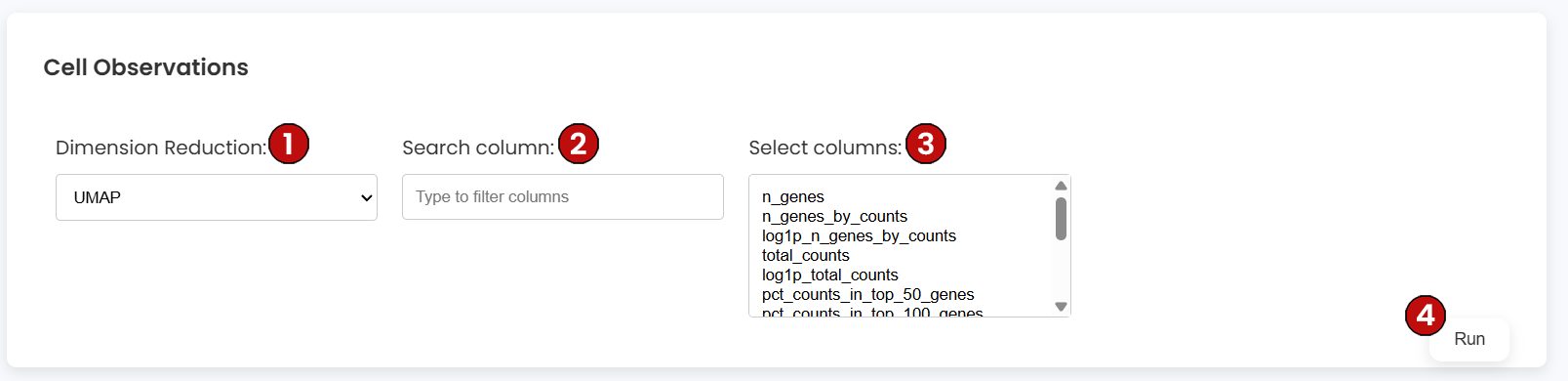
Cell Observations Plots
Use the Cell Observations container to color the embedding by per-cell metadata stored in obs (e.g., total counts, percent mitochondrial, Leiden cluster, user labels). Configure:
- (1) Dimension Reduction: Choose UMAP or PCA as the display space.
- (2) Search column: Filter available
obs columns by name.
- (3) Select columns: Pick one or more
obs fields to visualize (numeric or categorical).
- (4) Run: Generate one plot per selected column.
Plots use continuous scales for numeric columns and discrete palettes for categorical columns (e.g., clusters/labels). This is ideal for QC review and for verifying labeling decisions before downstream analyses.